80% of a Great Website Is Strategy. The Other 20% Is the Icing.

I spoke to a bloke recently who runs a video agency. He’d found me on LinkedIn, read a post, gone to the profile, then over to the website, and booked the call.
The first thing he said when we got on was: “I knew from the website that I was in the right place. I could tell straight away from the messaging.”
Then he played it back to me. The specific problem it named. The kind of business it spoke to. The way the offer was framed. He’d absorbed the message clearly enough to repeat it back on a call two weeks later. Every touchpoint had told the same story. LinkedIn post, then profile, then website. Each one made him feel a bit more like he was talking to the right person. And that experience, he said, was exactly what he wants his own prospects to have.
That’s not a design achievement. The colours didn’t do that. The layout didn’t do that.
The strategy and the message did that.
I think about a website as about 80% strategy and message, and 20% design. The design is the icing. Good icing on a great cake makes everything better. Icing sitting on an empty plate is just confusing.
The problem is most people build websites starting with the 20%. They get excited about what it’s going to look like. They pick colours, browse templates, think about fonts. The strategy gets left until last. The fundamental thinking about who the site is for, what they care about, and what it needs to say to make them enquire. That tends to get done in a rush at the end, if it gets done at all.
That’s why so many websites look decent and convert nobody. The problem usually isn’t the design. It never was.
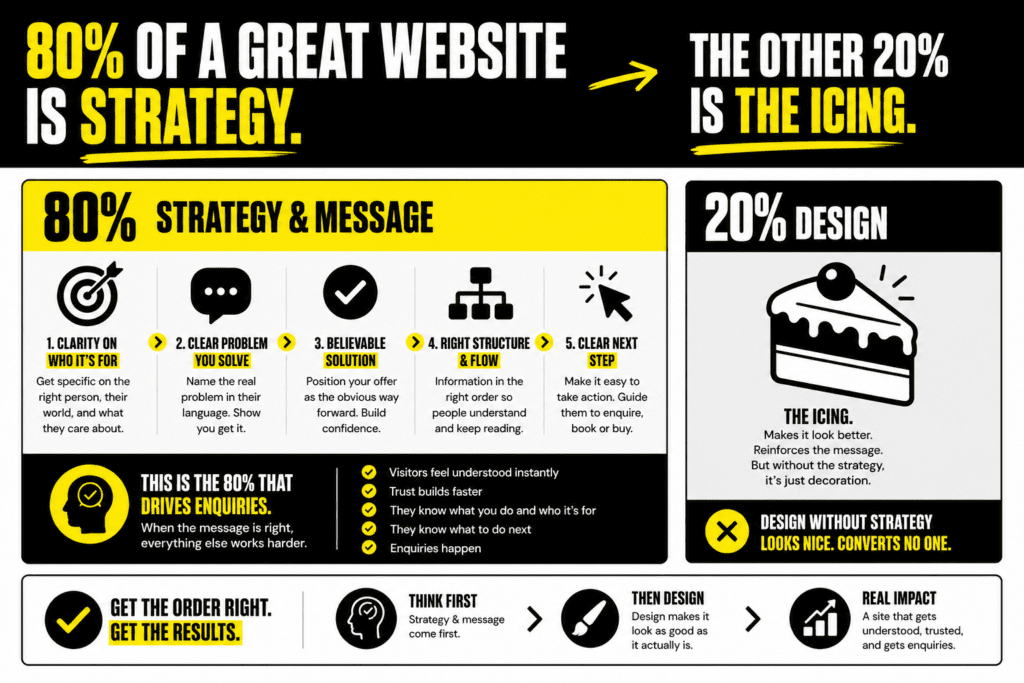
Strategy isn’t a buzzword. It’s just the thinking that has to happen before you build anything.
Who is this website for, precisely? What does that person care about, and what does the site need to make them believe before they’ll get in touch?
Get that thinking right and the rest follows. The copy has a target. The structure makes sense. The design has something worth making look good.
Skip it and you end up with a website written about your business, in your language, organised the way you think about things internally. Which is almost never how a potential client thinks about their problem. It might look the part, but it’ll lose people the moment they try to work out whether you’re the right fit.
Message is what comes out of the strategy. It’s the specific words you use to describe the problem you solve, the people you solve it for, and why you’re the right person to help.
It’s different for every business, and you can’t borrow it from someone else. You have to understand your client well enough to describe their situation back to them, clearly enough that they read it and think “yes, that’s exactly it.” That’s when trust starts to build and someone begins to believe you understand their world.
That’s what happened with the video agency client. He felt understood by the website. Then he booked the call. Then he sat on that call and told me exactly why.
I don’t blame anyone for starting with design. It’s the visible part. “Does this look good?” is a question you can answer in seconds. “Does this say the right thing to the right person in the right order?” takes more time and thought, and can’t be evaluated with a quick scroll.
So people gravitate toward the bit they can act on quickly. They pick the template, choose the palette, get excited about the hero image. The copy ends up written at speed, about themselves, in their own words, because no one’s helped them think it through. The site goes live looking solid and saying nothing to anyone in particular.
Six months later, still no enquiries.
I built a site recently for a family member. Colin. He’s a plumber in Grimsby, bored of retirement and starting his business up again.
We could’ve knocked something together quickly and got it live.
We didn’t. I ran exactly the same Blueprint process I run with every paying client. The questionnaire. The strategy document. The messaging. The page-by-page plan. All of it done before a single thing got designed or built.
Because a website without strategy isn’t really a website. It’s just a web page. And a business starting from scratch needs something that does a job from day one, not something that has to be ripped up and rebuilt six months later when it’s not working.
The strategy doesn’t make the process longer. It makes the output worth building.
Someone lands on the website. Reads the first 20 words. Knows whether they’re in the right place.
They’re not thinking about the colours. They’re not registering the layout. The message is doing its job before the design even gets noticed.
That’s the 80% working. The design makes it look as good as it actually is. But strategy and message is what makes someone enquire, book a call, and sit on that call telling you exactly why your website was the thing that convinced them.
If that’s not happening for yours, the strategy is where I’d start looking. Not the design.